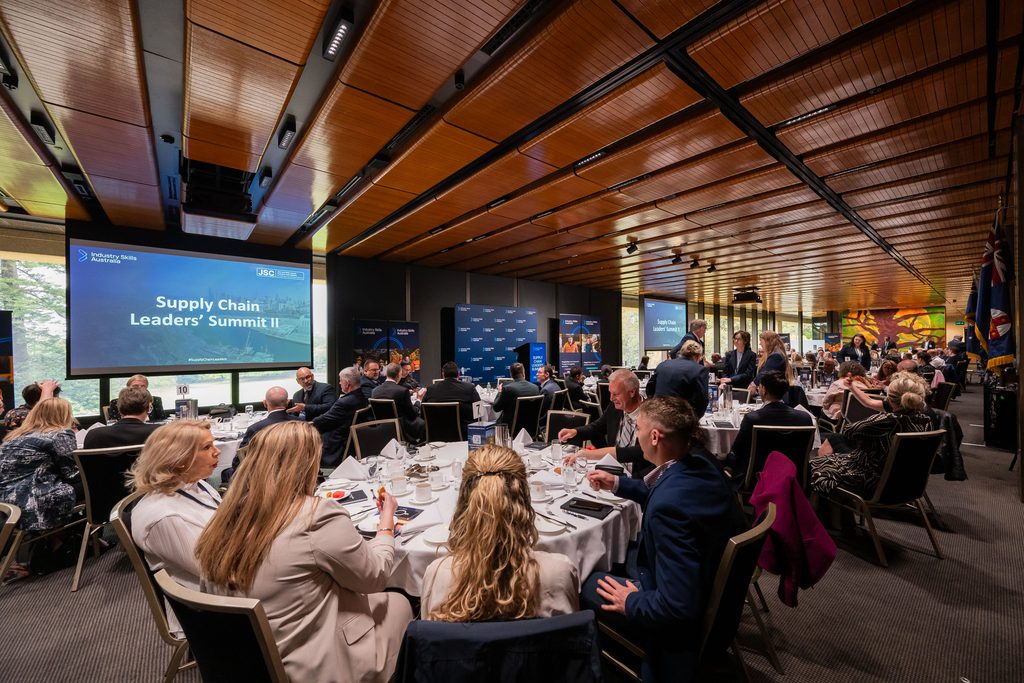
Industry Skills Australia (ISA) brought together leaders from industry, unions, government and training providers at NSW Parliament for its second Supply Chain Leaders’ Summit. Attendees were united by a common goal: lifting productivity through skills.
Building on the momentum of ISA’s inaugural Summit in 2024 and the continued engagement throughout 2025-26, senior leaders from across the transport supply chain gathered to reinforce the importance of building a productive, resilient and future-focused workforce.
The Summit showcased industry-led initiatives including the launch of the Employer Hub, National Heavy Vehicle Driver Action Plan and highlighted ISA’s upcoming careers promotion work, all of which were key priorities identified by industry at the inaugural Summit in 2024.
The discussions and initiatives affirmed a clear message: improving productivity is a shared responsibility. Continued collaboration will be essential to address workforce priorities, improve skills outcomes across the sector, and build a workforce capable of meeting the future needs of Australia’s transport supply chain industries.
ISA Chair Catherine Baxter opened the Summit by highlighting the importance of the transport supply chain to Australia’s economy, noting that its productivity depends on a workforce with the skills, adaptability and expertise to meet the changing needs of industry. She reinforced the importance of workforce capability, stating that “skills and adaptability are essential to the supply chain industry to maintain productivity.”
Catherine also emphasised that the Summit provided an opportunity to acknowledge industry priorities and focus on practical solutions, noting that “the real value comes from being able to turn that information into practical action.” She highlighted the importance of collaboration in addressing workforce challenges, stating that “no one has the remit to do it on their own; we have to collaborate, listen and learn from each other and across industries to improve productivity.”
Catherine launched ISA’s Employer Hub, describing it as an important step in supporting employers across the transport supply chain navigating workforce and skills development. The Hub has been developed as a practical resource for businesses, bringing together workforce insights, industry intelligence, funding opportunities and tools that help employers attract, retain and develop skilled workers. By providing easy access to information and support, the Employer Hub will help employers make informed workforce decisions, build capability and respond to the evolving skills needs of the industry.
The Hon. Andrew Giles MP, Minister for Skills and Training acknowledged the strength of the tripartite representation in the room and ISA’s efforts in bringing together industry, union and government representatives to identify workforce needs and drive solutions. Minister Giles highlighted the critical role Jobs and Skills Councils play in workforce planning and acknowledged that workforce demand across Australia’s transport supply chain industries will continue to grow. He stressed the need to support both regional and metropolitan communities while building a workforce that meets the needs of today and the future.
Steve Thompsett, CEO, DHL Supply Chain Australia and New Zealand, challenged delegates to focus on what matters most, delivering a simple but powerful message: “It’s about intensity, consistency and curiosity.” His insights reinforced the importance of strong leadership, accountability and optimism in building a productive and resilient supply chain workforce.
Senator Glenn Sterle formally launched the National Heavy Vehicle Driver Action Plan, developed by ISA in partnership with Industry leaders. The Action Plan addresses heavy vehicle driver shortages and supports a collaborative, industry-led approach to workforce planning and development.
The Senator described the Action Plan as a practical example of what can be achieved when industry, unions and government work together. Reflecting on the significance of the initiative, he remarked that “when trucks stop, Australia stops”, reinforcing the critical role heavy vehicle drivers play in keeping Australia’s economy moving.
He emphasised that the Action Plan was developed by industry, for industry, and challenged stakeholders to ensure it becomes a catalyst for action rather than another report left on a shelf. Drawing on his lifelong connection to the transport industry, Senator Sterle stressed the importance of maintaining momentum and viewing the investment in drivers as part of a long-term plan to attract, train and retain a sustainable and skilled workforce.
Luke Day and Miriam David from Toll Group joined the Summit for a Fireside Chat to share their firsthand experiences in delivering industry-led initiatives that support diverse and underrepresented cohorts joining the workforce.
Discussing Toll Group’s First Nations Traineeship Program and the Employment Pathway Program, developed with We are Mobilise, the conversation showcased practical examples of how industry are responding to workforce shortages by broadening participation to build a stronger, more productive workforce.
The Industry Leaders’ Panel featured senior leaders from across the transport supply chain including Claire Storey (Melbourne Airport), Nancy Ilacqua (Metro Trains Sydney), Liz Watchman (Svitzer Australia), Mathew Munro (Australian Trucking Association) and Emily McMillan (Transport Workers’ Union of Australia).
The discussion explored the changing expectations of a new generation of workers, the emergence of new skills requirements and the importance of creating more accessible pathways into and across industries. Panellists emphasised the need for greater transparency, stronger communication, clearer career pathways and more effective promotion of industry opportunities to current and future workers.
While Aviation, Rail, Maritime and Transport and Logistics faces their own challenges, the panel made clear the significant commonality across the transport supply chain industries. Panellists highlighted the need for solutions that look beyond individual industries, recognising that addressing shared workforce challenges requires a coordinated, cross-industry approach.
ISA CEO Dr Vanda Fortunato concluded the day by outlining ISA’s role in translating industry insights into practical, industry-aligned responses to workforce challenges. She highlighted ISA’s work to strengthen workforce diversity, raise awareness of transport supply chain careers and expand pathways into the industries, emphasising that delivering lasting solutions will depend on ongoing collaboration with industry, governments and unions.
As Vanda noted: “We have the demand. We need to understand the skills required, the changes in training and the impact of technology. We need to stay involved, remain adaptable and work together to build the workforce our industries need.”
Vanda also shared ISA’s upcoming Careers Information campaign, developed in collaboration with an industry advisory group to challenge perceptions and showcase the breadth of career opportunities across the transport supply chain. Under the tagline One career, endless places to go, the campaign will bring real career stories to life and highlight the many pathways available across the industries. Vanda encouraged attendees to stay engaged with ISA, share their experiences and continue collaborating across industry boundaries to ensure solutions remain relevant, industry-led and responsive to shared workforce challenges.
The Summit served as a reminder that the solutions already exist within the room. The challenge now is to continue working together, turning ideas into action and ensuring Australia’s supply chain workforce is equipped for the future.